
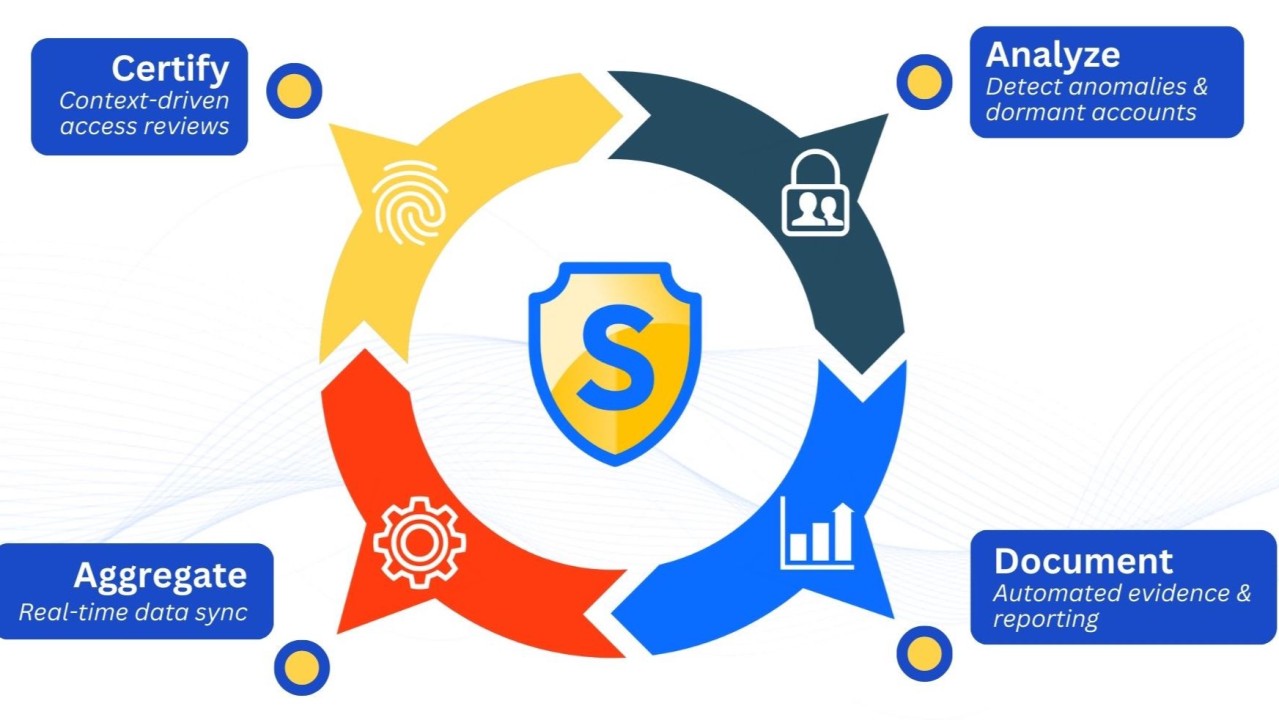
The Continuous Governance Engine: How It Works
Moving from a point-in-time review to a continuous model requires a fundamental change in process. It operates like a persistent, intelligent engine:
- Continuous Data Collection: Instead of pulling data once a quarter, the system constantly ingests identity data from all your sources—HRIS, cloud apps, infrastructure, and on-premises directories. It sees every change as it happens.
- Policy-as-Code: Your governance policies (e.g., “No single user should be a Global Admin in both AWS and Azure,” or “Finance users cannot have production database access”) are written as code and enforced automatically. The system doesn’t wait for a review; it flags violations in real-time.
- Automated Remediation Workflows: When a violation or anomalous access is detected (like an orphaned account or a privilege escalation), it doesn’t just sit in a log. The engine can trigger automated workflows: send an alert to the security team, notify the data owner for immediate review, or in some cases, even automatically revoke the dangerous access.
- Always-On Audit Trail: Every single access change, policy decision, and automated action is logged immutably. You’re not building an audit package after the fact; it’s being built for you, second by second, in the background.
Why This Matters More Than Ever
Why is this shift so critical? The answer is simple: Attackers don’t operate on a quarterly schedule.
They exploit the gaps that inevitably open between manual reviews. They hunt for the dormant account of a former employee, the excessive privilege granted “temporarily” six months ago, or the orphaned entitlement in a forgotten SaaS app. These are the blind spots in a periodic system.
Continuous Identity Governance closes these gaps as they appear. It’s not just about proving to an auditor that a review happened last quarter; it’s about systematically eliminating the windows of opportunity that attackers rely on.
The Bottom Line: From Audit-Ready to Attack-Resistant
Stop treating governance as a project with a start and end date. Start treating it as a foundational, ongoing process.
When your identity security is always on, you fundamentally change your relationship with risk. You move from simply being audit-ready—which is a reactive, defensive posture—to being truly attack-resistant. You build an environment where excessive privileges and policy violations are the exception, not the norm waiting to be discovered.
In your experience, what’s the biggest bottleneck preventing teams from achieving this vision of “continuous” governance? Is it budget, tooling, skills, or organizational buy-in? I’d love to hear your perspective in the comments.