
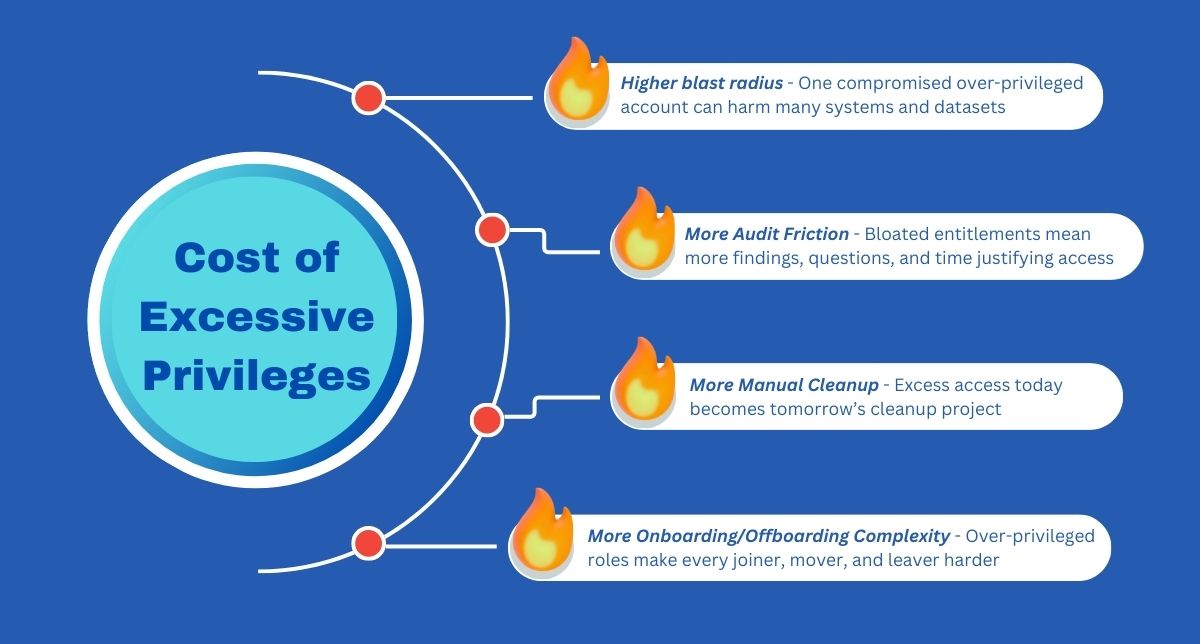
The Four Faces of the Privilege Tax
1. 🔥 A Higher Blast Radius (The Security Risk)
Yes, this is the classic risk. When a user account with excessive privileges is compromised—whether through a phishing attack, credential theft, or an insider threat—the damage is magnified. The attacker can access more sensitive data, disrupt critical systems, and move laterally across your environment faster. The financial, operational, and reputational impact scales directly with the level of privilege. This is the immediate, headline-grabbing cost.
2. 🔥 More Audit Friction (The Compliance Cost)
Auditors are trained to scrutinize privileged access. The more admin accounts, custom roles, and standing exceptions you have in your environment, the more questions you will face. Every deviation from a standard, clean model becomes a point of inquiry. This translates directly into longer, more expensive audits. It often leads to formal findings that require costly remediation plans and can even impact audit opinions. A cluttered permission model makes your compliance journey an uphill battle.
3. 🔥 More Manual Cleanup (The Operational Waste)
Excessive privileges don’t revoke themselves. They accumulate like digital debt. This means that every quarter, your security and identity teams are forced to spend valuable cycles manually reviewing and justifying a tangled web of entitlements that likely shouldn’t exist in the first place. This is the definition of operational toil—pure waste of skilled labor that could be spent on strategic initiatives like cloud architecture or threat hunting.
4. 🔥 More Onboarding/Offboarding Complexity (The HR & IT Friction)
Complex permissions create complex processes. When access isn’t standardized, every step in the employee lifecycle becomes harder:
- Onboarding: More complex permissions mean more steps for IT to manually configure, delaying a new hire’s ability to be productive.
- Offboarding: A sprawling, poorly documented access landscape creates a higher chance of missing a critical system during deprovisioning, leaving a security gap.
- Role Changes: Moving a user to a new role becomes a guessing game of what old access to remove and what new access to add.
Slow onboarding frustrates new talent, while slow offboarding creates a silent, persistent security risk.
The Bottom Line: Least Privilege as an Operational Strategy
Least privilege isn’t just about control or locking things down. It’s fundamentally about operational simplicity.
A clean, minimal, and justified access model delivers benefits across the entire business:
- Faster Incident Response: You can quickly understand the impact of a compromised account when privileges are minimal and well-documented.
- Smoother Audits: A clean model answers auditor questions before they’re asked, shortening the process and building trust.
- Less Manual Toil: Your best people are freed from spreadsheet drudgery to focus on high-value work.
- More Reliable Automation: Clean, standardized access is the prerequisite for automating HR-driven provisioning and deprovisioning.
When you systematically reduce excessive privileges, you’re not just reducing security risk. You are actively reducing friction, complexity, and cost across your entire organization. Eliminating the silent tax of over-permissioned users is one of the highest-ROI investments you can make in your operational excellence.
Where have you felt the operational “tax” of over-permissioned users the most in your organization—during audits, onboarding, or day-to-day management? Share your experiences in the comments.