
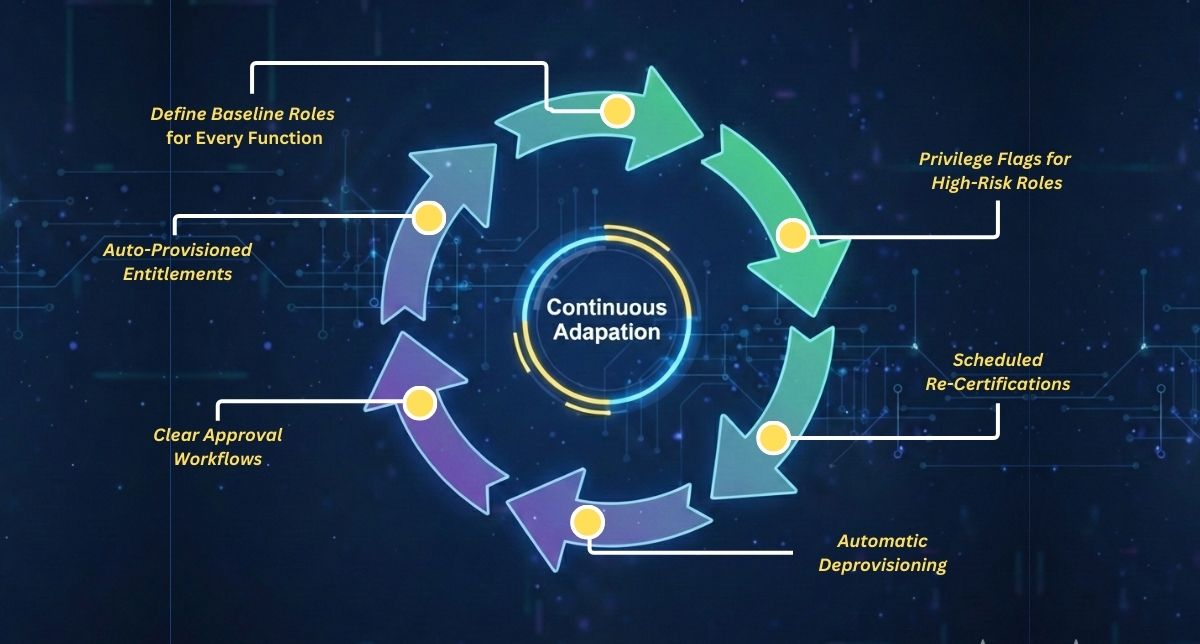
The 6 Pillars of a Scalable RBAC System
To move from a static headache to a dynamic enabler, your identity framework needs to be built on these six core principles:
1. Baseline Roles for Every Function
Start by defining core, standardized roles that map clearly to common job functions. Think “Backend Engineer,” “Data Analyst,” “Finance User.” The key is to grant only the access truly needed to perform that specific role, adhering to the principle of least privilege. Begin with a tight scope—you can always expand permissions based on validated need, but it’s much harder to safely rein in overly broad access later.
2. Auto-Provisioned Entitlements via HRIS/IdP Integration
Your RBAC shouldn’t live in a silo. Integrate it directly with your HRIS (like Workday or BambooHR) and your Identity Provider (IdP, like Okra or Azure AD). When an employee is hired, changes teams, or is promoted, their core entitlements should be automatically assigned based on their new role. This eliminates manual IT tickets for standard access, reduces provisioning delays, and removes a major source of human error.
3. Clear Approval Workflows for Privileged Access
For any non-standard access or temporary privilege elevation, you need clear, auditable workflows. A developer needing temporary production database write access shouldn’t be given a standing role. Instead, they should request it through a system that logs the business justification (“the why”), routes it to the appropriate manager for approval, and crucially, sets an auto-expiry on that elevated access. This creates a secure, time-bound process.
4. Privilege Flags for High-Risk Roles
Not all roles are created equal from a risk perspective. You must systematically identify, tag, and monitor high-risk roles—such as “Cloud Admin,” “Billing Owner,” or “Global Schema Admin.” Any assignment or modification of these privileged roles should trigger an immediate alert and require heightened justification. These roles should also be subject to a more frequent review cadence than standard user roles.
5. Scheduled Re-Certifications
Roles drift. As business needs change and the underlying cloud services evolve, the permissions within a role can accumulate, leading to “permission creep.” To combat this, schedule regular re-certification campaigns—quarterly or bi-annually. In these campaigns, role owners must actively review and re-certify that the permissions associated with their roles are still accurate, necessary, and compliant with policy.
6. Automatic Deprovisioning
The end of the access lifecycle is the ultimate test of your RBAC integrity. When a user’s role changes or they leave the organization, access tied to the old role must be automatically removed across all integrated systems. This isn’t just a security best practice; it’s a non-negotiable compliance requirement. Automated deprovisioning closes the loop and prevents orphaned accounts from becoming a liability.
Why This Shift in Mindset Matters
Treating RBAC as a living system transforms it from a compliance bottleneck into a true business enabler. It reduces friction for employees, getting them the right access at the right time, while simultaneously giving security and compliance teams the automated control and granular evidence they need to satisfy auditors.
The Bottom Line
Your cloud stack and business priorities will never stop evolving. Your access model shouldn’t either. By building RBAC to be adaptive from the start, you’ll save countless hours of manual cleanup, reduce security risk, and eliminate audit pain down the road. It’s an investment in a foundation that truly scales.
What’s been the biggest challenge in maintaining your RBAC system as you’ve scaled? Share your experiences in the comments below.